Older Crash Patients and Concussion: A Pinellas Provider's Guide
Concussion in older crash patients is easy to miss. What St. Petersburg, Clearwater and Largo providers should watch for, and when to send a patient back to the ER.
Picture a common visit. A 74-year-old patient comes in a week after a crash on US-19 in Clearwater. Her neck is sore, which is why she is here. Her daughter mentions, almost in passing, that Mom has been "a little off" since the accident: repeating questions, napping more, losing track of conversations. It would be easy to put that down to age, to poor sleep or to the stress of the crash.
In Pinellas County, providers see this patient often. This guide covers why concussion in older crash patients is easy to miss and what a careful first visit can capture.
Key takeaways
- 28.7% of Pinellas County residents are 65 or older (U.S. Census Bureau).
- The CDC says TBI may be missed in older adults because symptoms overlap with conditions such as dementia.
- Blood thinners may raise the risk of bleeding in the brain after a TBI.
- A dated, structured history at the first visit makes slow changes easier to see.
Why this matters in Pinellas

According to the U.S. Census Bureau, 28.7% of Pinellas County residents are 65 or older, well above the national share. Florida's 2024 Traffic Crash Facts report counts 77,271 drivers aged 65 and older involved in crashes statewide. Pinellas alone recorded 14,391 crashes and 8,804 injuries that year.
Many older patients are seen first at one of the county's emergency departments, including Orlando Health Bayfront Hospital in St. Petersburg (the county's adult Level II trauma center), Morton Plant Hospital in Clearwater, St. Anthony's Hospital in St. Petersburg, Mease Dunedin Hospital and HCA Florida Largo Hospital. Those teams focus, correctly, on bleeding, fractures and other emergencies. Concussion follow-up often lands with the next provider the patient sees, which is frequently a chiropractor or primary care office.
Why concussion hides in older patients
The CDC notes that TBI may be missed or misdiagnosed in older adults because its symptoms overlap with other conditions that are more common at that age, such as dementia. Memory lapses, slowed thinking, unsteadiness and changes in sleep can look like a bad week, a medicine side effect or normal aging.
Recovery can also take longer. The CDC lists older adults among the groups whose recovery from a mild TBI or concussion may be slower.
Memory lapses, slowed thinking and unsteadiness can look like a bad week, a medicine side effect or normal aging.
Blood thinners change the calculation
The CDC asks healthcare providers to check for signs and symptoms of TBI whenever an older adult has been in a car crash, and says this is especially important for patients taking blood thinners. Its examples include anticoagulants such as warfarin, rivaroxaban and apixaban, and antiplatelet medicines such as clopidogrel, ticagrelor and aspirin. These medicines may raise the risk of bleeding in the brain after a TBI.
The research is reassuring in some ways and not in others. In an Ontario cohort of 69,321 adults aged 65 and older seen in the emergency department for head injury, delayed intracranial hemorrhage within 90 days occurred in 1.0% of patients overall and 1.8% of those on warfarin (Liu et al., CJEM, 2022). Direct oral anticoagulants were not linked to a higher risk in that study, and a 2022 meta-analysis found lower bleeding risk with them than with warfarin (Santing et al., Journal of Neurotrauma). Lower is not zero. Age 65 and older is itself a high-risk factor in the Canadian CT Head Rule.
History questions worth asking
A short, structured history at the first visit makes later changes easier to see:
- Did the head strike anything, or was it a sudden jolt? Any loss of consciousness or gap in memory?
- Which blood thinners or antiplatelet medicines is the patient taking, and was imaging done?
- What does a family member or caregiver notice that the patient does not?
- Any new falls, unsteadiness or dizziness since the crash?
- How is the patient managing medicines, bills, driving and other daily tasks compared with before?
Write down the answers with dates. Comparing them at the next visit is often how a slow change gets noticed.
When testing adds value
Testing does not replace your exam. When you decide it makes sense, Braintree's mobile team performs concussion and TBI testing at your own office in St. Petersburg, Clearwater, Largo, Pinellas Park, Dunedin, Tarpon Springs and nearby communities, so older patients do not need another drive across the county. Scheduling is coordinated with your office.
Results are delivered as physician-reviewed diagnostic reports, and you keep the clinical decisions. See how [concussion and TBI testing](https://braintreehealth.org/concussion-tbi-testing) works, learn about [mobile testing in St. Petersburg and Clearwater](https://braintreehealth.org/st-petersburg-clearwater), or [send a referral](https://braintreehealth.org/referral). Patients and families can read our [For Patients page](https://braintreehealth.org/for-patients), and recent local crashes appear on the [St. Petersburg & Clearwater Crash Map](https://braintreehealth.org/st-petersburg-clearwater#crash-map).
Frequently asked questions
Why is concussion harder to spot in older adults?
The CDC notes that TBI symptoms in older adults can overlap with other conditions, such as dementia, so memory or balance changes may be put down to aging.
Why do blood thinners matter after a crash?
The CDC says blood thinners such as warfarin, apixaban, rivaroxaban, clopidogrel and aspirin may raise the risk of bleeding in the brain after a TBI, so checking older crash patients for TBI signs is especially important.
Are newer blood thinners safer than warfarin after a head injury?
Studies suggest a lower bleeding risk with direct oral anticoagulants than with warfarin, but the risk is not zero and age 65 or older is itself a risk factor.
Can Braintree test patients at my Pinellas office?
Yes. The mobile team tests at the referring provider's office across St. Petersburg, Clearwater, Largo, Pinellas Park, Dunedin, Tarpon Springs and nearby areas.
Who makes the clinical decisions?
You do. Braintree provides physician-reviewed diagnostic reports to the referring provider, who keeps all diagnosis and treatment decisions.
Sources
- U.S. Census Bureau QuickFacts: Pinellas County, Florida
- FLHSMV: Florida Traffic Crash Facts Annual Report 2024
- CDC: Facts about TBI (older adults and blood thinners)
- CDC: What to do after a mild TBI or concussion
- Liu S et al. Delayed intracranial hemorrhage after head injury among elderly patients on anticoagulation seen in the emergency department. CJEM. 2022;24(8):853-861
- Santing JAL et al. Mild traumatic brain injury in elderly patients receiving direct oral anticoagulants: a systematic review and meta-analysis. J Neurotrauma. 2022;39(7-8):458-472
- Stiell IG et al. The Canadian CT Head Rule for patients with minor head injury. Lancet. 2001;357(9266):1391-1396
- Orlando Health Bayfront Hospital: Emergency services and trauma care
- Florida Department of Health: Florida trauma centers (updated July 23, 2026)
- BayCare Morton Plant Hospital, Clearwater
- BayCare St. Anthony's Hospital, St. Petersburg
- BayCare Mease Dunedin Hospital
- HCA Florida Largo Hospital
- CDC: Symptoms of mild TBI and concussion (including danger signs)
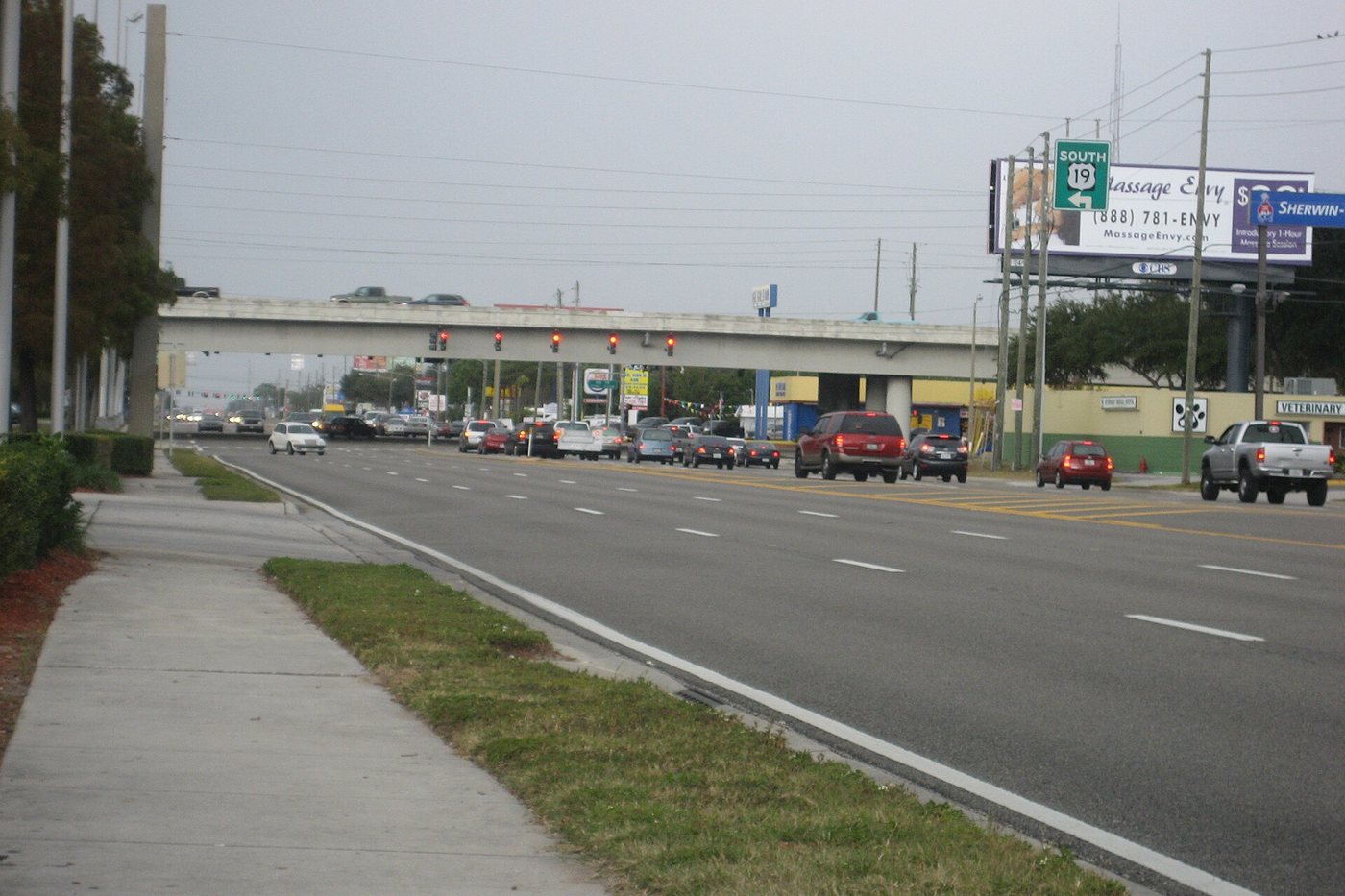
Photo credits: Prescription review, via Pexels. State Road 580 at U.S. 19 in Clearwater, Rko202 (public domain), via Wikimedia Commons.
This article is educational and is not medical or legal advice. If this is a medical emergency, call 911.