
T-Bone Crashes and Concussion: What Port St. Lucie and Treasure Coast PI Teams Should Know
Why side-impact (T-bone) crashes on US-1, Port St. Lucie Boulevard and other Treasure Coast intersections deserve a careful look for concussion, and which details make the record easier to follow.
Consider a hypothetical client. He is 38 and works in Tradition. On his way home he crosses US-1 at Port St. Lucie Boulevard on a green light. A pickup coming the other way turns left across his path and strikes his car on the passenger side.
He was the only person in the car. The side curtain airbags deployed. At the scene he said he felt "rattled" but declined transport. Three weeks later he is losing his train of thought at work, headaches start by midafternoon, and he is sleeping badly.
Key takeaways
- St. Lucie, Martin and Indian River counties recorded 10,776 crashes and 6,805 injuries in 2024 (FLHSMV).
- After adjusting for crash factors, lateral impacts carried about 2.6 times the risk of serious TBI (Bazarian et al., 2004).
- Far-side occupants had a similar risk of serious head injury to near-side occupants (Ryb et al., 2009).
- A deployed side curtain airbag lowers head-injury risk. It does not show that no concussion occurred.
The damage is on the side away from him, and the first question from the other side is how a far-side driver could have hurt his head. This article looks at what the research says about side impacts and what clearer concussion records tend to include. It is educational only and is not legal advice.
Side impacts are a familiar Treasure Coast crash pattern
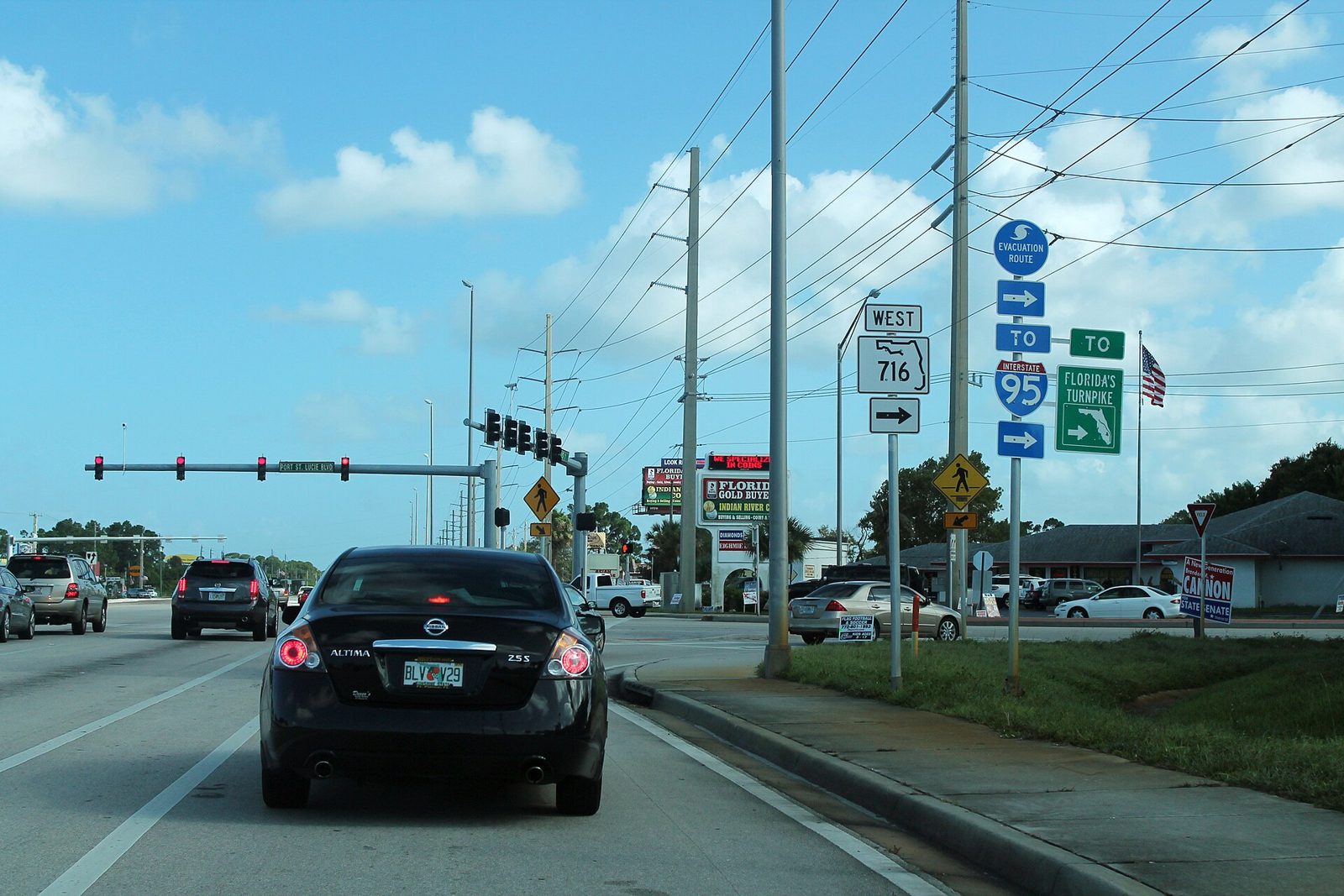
Florida's 2024 Traffic Crash Facts report counts 5,666 crashes and 3,402 injuries in St. Lucie County, 2,945 crashes and 2,018 injuries in Martin County, and 2,165 crashes and 1,385 injuries in Indian River County. That is 10,776 crashes and 6,805 injured people across the three counties in one year. Statewide, the same report lists more than 97,000 people injured in intersection crashes.
Much of the Treasure Coast's traffic funnels through signalized intersections on US-1, Port St. Lucie Boulevard, Prima Vista Boulevard, St. Lucie West Boulevard, Gatlin Boulevard, Okeechobee Road (SR-70) in Fort Pierce, Kanner Highway in Stuart and SR-60 in Vero Beach. Left turns and red-light crossings at intersections like these are a common setting for side impacts. The report does not break out crash type by county, so the local picture should be read from the individual crash reports.
What the research says about side impacts and the head
Side impacts make up a meaningful share of serious crashes. In IIHS figures for 2024, side impacts accounted for 22% of passenger-vehicle occupant deaths, and 26% for car occupants.
A 2004 analysis of national crash data in Annals of Emergency Medicine found that, after adjusting for crash factors, occupants in lateral impacts had about 2.6 times the risk of serious traumatic brain injury compared with other impact directions, and those brain injuries were more severe (Bazarian et al.). That study looked at serious brain injury, not mild concussion. It still shows why the head deserves attention when a car is struck from the side.
Being on the far side does not mean the head is protected. In a trauma-center study, far-side occupants had a risk of serious head injury similar to near-side occupants. The head most often struck structures on the opposite side of the car, or another occupant (Ryb et al., Journal of Trauma, 2009).
Side airbags help. Front-seat occupants whose head-protecting side airbag deployed had a 30% lower risk of moderate or worse head injury (Griffin et al., 2012). A deployed curtain airbag is a sign of the crash forces involved, not proof that no injury occurred.
Being on the far side of a T-bone crash does not mean the head was protected.
Record details worth noticing
When Treasure Coast side-impact files are read closely, a few gaps come up often:
- No note of which side was struck or where the client was sitting.
- No mention of which airbags deployed, or whether the head contacted the window, pillar or another person.
- "Denies loss of consciousness" recorded with no questions about feeling dazed or memory gaps.
- Neck and shoulder findings documented in detail while thinking, mood and sleep go unasked.
- No standardized, dated measure of brain function after the crash.
Florida's PIP statute, section 627.736, ties medical benefits to initial care within 14 days after a crash. Prompt care protects the person's health first. A clearer record follows from it.
Where testing fits
Testing decisions belong to the client's treating provider, such as a primary care physician, chiropractor, orthopedist or pain physician. When that provider decides testing makes sense, Braintree's mobile team performs concussion and TBI testing at the provider's own office in Port St. Lucie, Fort Pierce, Tradition, Stuart, Jensen Beach, Palm City, Vero Beach, Sebastian and nearby communities. Scheduling is coordinated with the referring provider.
Results become physician-reviewed diagnostic reports that go to the treating provider, who reaches their own clinical findings. Braintree makes no promise about the outcome of any case. Learn more about concussion and TBI testing in Florida and mobile testing in Port St. Lucie and the Treasure Coast. Treating providers can send a referral.
Court context
Indian River, Martin, Okeechobee and St. Lucie counties make up Florida's Nineteenth Judicial Circuit. HCA Florida Lawnwood Hospital in Fort Pierce is the area's Level II trauma center and serves patients from all four counties. Adjusters, mediators and jurors are usually not clinicians, so notes that describe the crash direction, seating position and symptoms in order are easier to follow.
Recent local crash reports appear on the Port St. Lucie and Treasure Coast Crash Map. Clients and families can read our For Patients page.
Frequently asked questions
Can a T-bone crash cause a concussion if the car was hit on the other side?
It can. In a trauma-center study, far-side occupants had a similar risk of serious head injury to near-side occupants, often from striking the opposite side of the car or another person.
Do side-impact crashes carry a higher risk of brain injury?
In a 2004 analysis of national crash data, lateral impacts carried about 2.6 times the adjusted risk of serious traumatic brain injury compared with other directions. That study looked at serious injuries, not mild concussion.
Does a deployed side curtain airbag mean there was no head injury?
No. Head-protecting side airbags were linked to a 30% lower risk of moderate or worse head injury, which is a meaningful reduction. It does not mean a concussion could not have happened.
Which court handles crash cases in St. Lucie, Martin and Indian River counties?
Those counties, along with Okeechobee County, make up Florida's Nineteenth Judicial Circuit. Questions about any specific case belong with counsel.
Can a client get concussion testing near Port St. Lucie, Stuart or Vero Beach?
If the client's treating provider decides testing makes sense, Braintree's mobile team can test them at that provider's office. Scheduling is coordinated with the provider.
Sources
- FLHSMV: Florida Traffic Crash Facts Annual Report 2024
- IIHS-HLDI: Fatality Facts 2024, passenger vehicle occupants
- Bazarian JJ et al. Lateral automobile impacts and the risk of traumatic brain injury. Ann Emerg Med. 2004;44(2):142-152
- Ryb GE et al. Expected differences and unexpected commonalities in mortality, injury severity, and injury patterns between near versus far occupants of side impact crashes. J Trauma. 2009;66(2):499-503
- Griffin R et al. Association between side-impact airbag deployment and risk of injury: a matched cohort study using the CIREN and the NASS-CDS. J Trauma Acute Care Surg. 2012;73(4):914-918
- CDC: Symptoms of mild TBI and concussion (including danger signs)
- Florida Statutes s. 627.736 (2026): Required personal injury protection benefits
- Florida Statutes s. 26.021 (2026): Judicial circuits
- Florida Department of Health: Florida trauma centers (updated July 23, 2026)
- HCA Florida Lawnwood Hospital, Fort Pierce (Level II Trauma Center)
Photo credits: St. Lucie County Courthouse, Fort Pierce, by Georgia Guercio, CC BY-SA 3.0, via Wikimedia Commons. US-1 South at SR-716, Port St. Lucie, by formulanone, CC BY-SA 2.0, via Wikimedia Commons.
This article is educational and is not medical or legal advice. If this is a medical emergency, call 911.