
Cyclists Hit Near the Pinellas Trail: Concussion Screening for Pinellas Providers
A cyclist who comes in for a sore shoulder or neck after being hit by a car may also have a concussion, helmet or not. A few intake questions help Pinellas providers decide when a closer look is worth arranging.
Who this is for: Written for chiropractors, primary care and urgent care physicians, orthopedic and physical therapy teams in Pinellas County who treat cyclists and e-bike riders after a crash with a car.
A commuter riding the Pinellas Trail in Largo is clipped by a turning car where the trail meets the street. She was wearing a helmet, walked away from the scene and comes to your office four days later for neck and shoulder pain. Another patient, riding an e-bike along Gulf Boulevard, is knocked off by a car door and mentions only a sore hip. These are hypothetical examples.
Both patients describe the injury they can feel. Neither may connect a headache, fogginess or trouble sleeping to the crash. This article offers screening questions for that visit. It is educational and is not medical advice.
Key takeaways
- Pinellas County recorded 806 bicyclist crashes and 757 bicyclist injuries in 2024, up from 652 crashes in 2023 (FLHSMV).
- Helmets reduced head injury by 48% and TBI by 53% in a meta-analysis, but a helmeted rider can still have a concussion.
- Patients who come in for neck or shoulder pain may not connect headaches, fog or poor sleep to the crash.
- Ask about the helmet, the head strike, memory around the crash and symptoms since, then decide on next steps.
The local picture
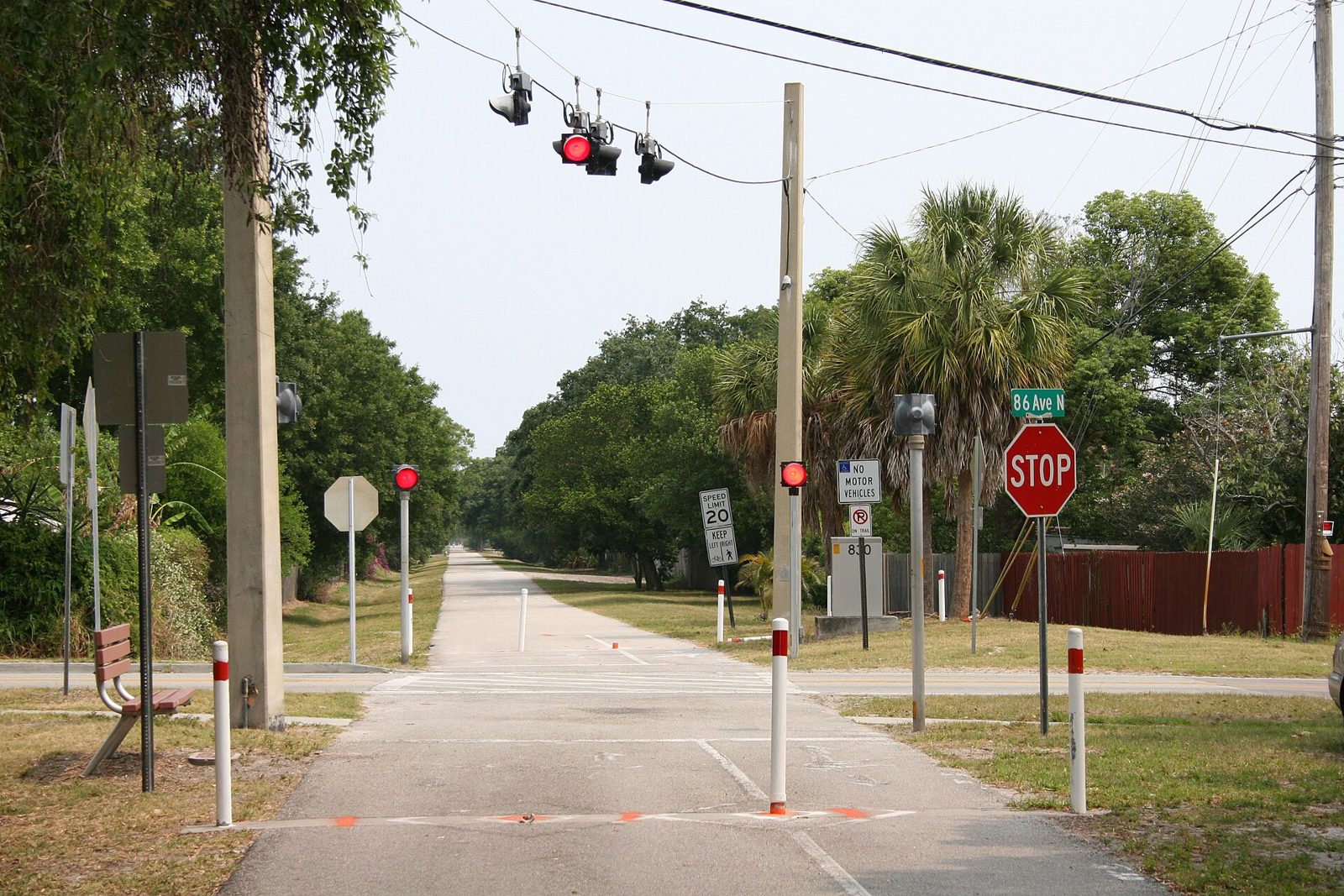
In 2024, Pinellas County recorded 806 bicyclist crashes, 757 bicyclist injuries and 13 bicyclist deaths, up from 652 crashes in 2023 (FLHSMV). Pinellas County describes the Fred Marquis Pinellas Trail as a 54-mile linear park used by about 250,000 residents and visitors a month. The county's trail rules allow electric bikes, and riders younger than 16 must wear a helmet, as Florida law also requires.
The county notes that overpasses and underpasses carry the trail over some busy roads, but the trail also meets local streets at crossings like the one pictured. Off the trail, cyclists share busy corridors such as US-19, Ulmerton Road, Gulf Boulevard and the approaches to the causeways.
A helmet lowers the risk but does not rule out concussion
A meta-analysis of 55 studies found that helmets reduced head injury among crash-involved cyclists by 48%, serious head injury by 60% and traumatic brain injury by 53%, but found no significant effect on cervical spine injury (Høye, 2018). That is a strong case for helmets. It also means a helmeted rider can still have a brain injury, and a rider with neck pain may have had a significant jolt.
The CDC notes that a concussion can follow a bump, blow or jolt to the head, or a hit to the body that moves the head quickly back and forth, and that some symptoms may not appear for hours or days.
"I had my helmet on, so I figured my head was fine" is worth a follow-up question.
Intake questions worth adding
- Was a helmet worn, and was it cracked, dented or replaced after the crash?
- Did the head hit the car, the windshield, the pavement or a curb?
- What is the last thing the patient remembers before the impact, and the first thing after it?
- Since the crash, any headaches, dizziness, sensitivity to light or noise, fogginess, trouble concentrating or changes in sleep or mood?
- Was it a pedal bike or an e-bike, and roughly how fast was the rider going?
- Has the patient been back on the bike or behind the wheel, and did that bring on symptoms?
These questions are a screen, not a diagnosis. MedlinePlus advises that a provider should tell a patient with a concussion when it is safe to ride a bicycle or drive again.
For related reading, see what chiropractors should know about adding concussion testing, how whiplash and concussion symptoms overlap, and how pedestrian and bicycle crash cases are documented.
When to send a patient to the ER
The CDC lists danger signs that call for emergency care right away, including a headache that gets worse and does not go away, repeated vomiting, weakness or numbness, slurred speech, seizures, growing confusion, one pupil larger than the other, or a patient who cannot be woken. In Pinellas County, Orlando Health Bayfront Hospital is the only state-accredited Level II adult trauma center, and Johns Hopkins All Children's Hospital in St. Petersburg is listed by the state as a pediatric trauma center.
Where testing fits
When you decide testing makes sense, Braintree's mobile team performs concussion and TBI testing at your office in St. Petersburg, Clearwater, Largo, Pinellas Park, Dunedin, Tarpon Springs and nearby communities. Scheduling is coordinated with your staff, and you receive physician-reviewed diagnostic reports. Care decisions stay with you.
Learn more about concussion and TBI testing, see mobile testing in St. Petersburg and Clearwater, or check recent local crashes on the St. Petersburg & Clearwater Crash Map. Patients can read what to expect.
Frequently asked questions
Can you get a concussion from a bike crash while wearing a helmet?
Yes. Helmets lower the risk: a meta-analysis of 55 studies found helmets reduced head injury by 48% and traumatic brain injury by 53% among crash-involved cyclists. A helmeted rider can still have a concussion, so symptoms after a crash should be checked by a provider.
How common are bicycle crashes in Pinellas County?
FLHSMV reported 806 bicyclist crashes, 757 bicyclist injuries and 13 bicyclist deaths in Pinellas County in 2024, up from 652 crashes in 2023.
Why screen a cyclist who came in for neck or shoulder pain?
The CDC notes that a concussion can follow a hit to the body that moves the head quickly, and that some symptoms appear hours or days later. A patient may not link a headache or poor sleep to the crash unless asked.
When can a patient with a concussion ride a bike again?
MedlinePlus advises that the patient's provider should say when it is safe to ride a bicycle, drive or return to other activities with a risk of another blow to the head.
Does Braintree test at Pinellas provider offices?
Yes. Pinellas County is a mobile service area, not an office location. Braintree's team tests at the treating provider's office and returns physician-reviewed diagnostic reports.
Sources
- FLHSMV: Florida Traffic Crash Facts Annual Report 2024
- Høye A. Bicycle helmets: to wear or not to wear? A meta-analyses of the effects of bicycle helmets on injuries. Accid Anal Prev. 2018;117:85-97
- CDC: About mild TBI and concussion
- CDC: Symptoms of mild TBI and concussion (including danger signs)
- MedlinePlus (U.S. National Library of Medicine): Concussion in adults, discharge
- Pinellas County: County celebrates 30 years of Pinellas Trail (2021)
- Pinellas County: Pinellas Trail guide (trail rules, electric bikes, emergency markers)
- Florida Statutes s. 316.2065 (2026): Bicycle regulations
- Orlando Health Bayfront Hospital: Emergency services and trauma care
- Florida Department of Health: Florida trauma centers
Photo credits: Pinellas Trail, by BucsWeb (Ronnie Boone), released into the public domain by the author, via Wikimedia Commons, resized. Pinellas Trail intersection, by BucsWeb (Ronnie Boone), released into the public domain by the author, via Wikimedia Commons, resized.
This article is educational and is not medical or legal advice. If this is a medical emergency, call 911.